ROV Fly to Place MQC Stabplate
Pressure-Compensated Multiple Quick Connect Stabplate
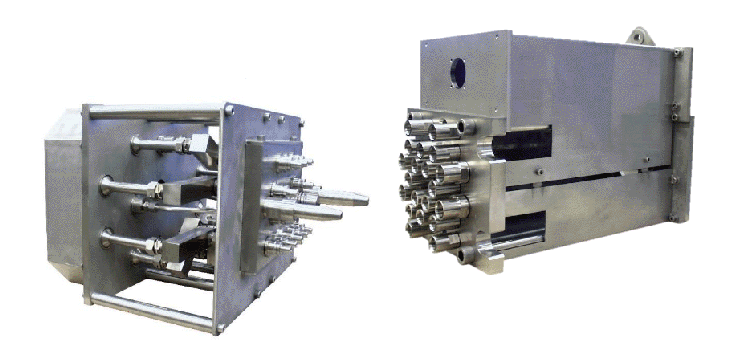
Multiple quick connect (MQC) stabplates are designed to be integrated to HFL, STFL and umbilical termination assemblies. The plate is built in two mating halves — an outboard plate on the flying lead and an inboard plate on subsea structure hardware — and is mated by ROV under full working pressure.
Working Pressure
Design Depth
Connector Type
The MQC stabplate is pressure compensated and designed for ROV free ‘fly to place’ deployment. Generous misalignment tolerances — ±75mm vertical/lateral and ±10° on the Z, Y and X axes — accommodate approach inaccuracy during flying-lead installation, while a guidance system and optional buoyancy package ease ROV handling. Coupling population is configurable up to 26 ways, with the stabplate available in Ø300 or Ø350 outside diameters and to client-specific lengths.
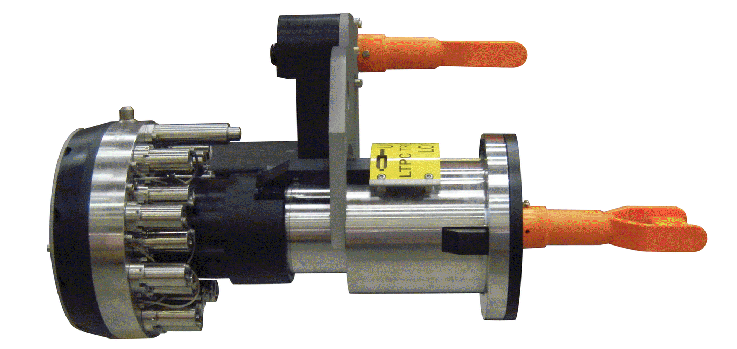
A built-in secondary release mechanism and an ISO 13628-8 Class 4 torque tool interface allow the connection to be recovered safely even if the primary lockdown cannot be released cleanly. The lockdown mechanism develops a 218 kN separation force, with the drive shaft in Hiduron 130 and the receptacle in UNS S31803 / UNS S32760; the male and female stabplates are UNS S31803 and ROV buckets are stainless steel 316L. Lifting points are designed and tested in accordance with DNV 2.7-3.
Options include LTPC (long term cover), male inboard plate, male parking plate, male and female test and flushing plates, plus any project-specific plates. Material certification can be supplied to EN 10204 3.1/3.2, and a full project reference list is available on request.
Key Features
- High quality robust design
- Built-in secondary release mechanism
- Mate and de-mate under full working pressure
- ISO 13628-8 Class 4 torque tool interface
- Guidance system and buoyancy option
- Lifting points designed and tested to DNV 2.7-3
- Material certification options to EN 10204 3.1/3.2
Materials
Applications
- Integrated into HFL, STFL and umbilical termination assemblies for subsea fluid and chemical distribution.
- Deployed by ROV free 'fly to place' approach, mating an outboard plate on the flying lead to an inboard plate on the subsea structure.
- Configurable as fixed or free stabplates, with long term cover and bend restrictor interface options.
Frequently Asked Questions
What is an MQC stabplate?
A multiple quick connect (MQC) stabplate joins many hydraulic and chemical lines in a single plate-to-plate connection. It is built in two mating halves — an outboard plate on the flying lead and an inboard plate on the subsea structure — and integrates with HFL, STFL and umbilical termination assemblies.
Can the stabplate be mated and de-mated under pressure?
Yes. MSCM MQC stabplates mate and de-mate under full working pressure — up to 15,000 psi — using a free-flying work-class ROV, with a built-in secondary release mechanism for safe recovery.
How many couplings can the plate carry, and to what depth is it rated?
Coupling population is configurable up to 26 ways in various sizes. The stabplate is designed for 3,000 m water depth with a 30-year design life, qualified to ISO 13628-6/7/8.
What ROV tooling interface does it use?
The lockdown mechanism is operated through an ISO 13628-8 Class 4 torque tool interface. A guidance system and optional buoyancy package assist ROV handling during fly-to-place deployment.
How much misalignment can it tolerate during mating?
The design accommodates ±75 mm vertical/lateral offset and ±10° of angular misalignment on all three axes, absorbing the approach inaccuracy typical of flying-lead installation.