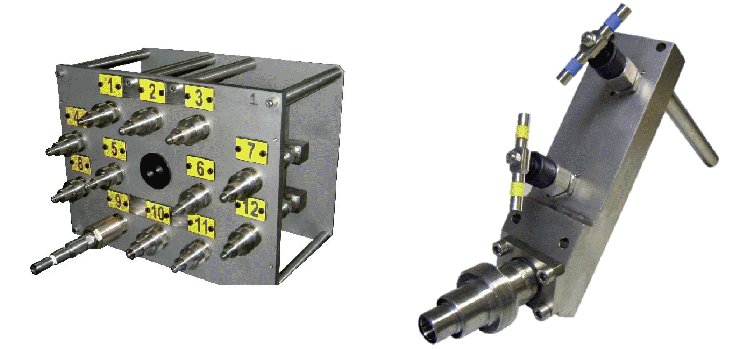
Block & Bleed Assemblies
High-Integrity Subsea Valve Assemblies
The block and bleed valve assembly is a low torque, soft seat rising plug shut-off valve with back seating. Key construction includes a PTFE gland stem seal and straight-through drillways utilising dual valves for the block and bleed mechanism.
Working Pressure
Connector Type
The colour-coded keying system — spanning angles from 36° through to 180°, plus a universal option — lets technicians confirm valve orientation and function at a glance during installation, reducing the risk of mis-routed lines on densely populated manifolds.
Diver-operable tee handle and ROV low-torque receptacle interfaces share the same base assembly, so a single design can be specified for either intervention method. Where double block and bleed isolation is required, the configurable arrangement combines two valves within a single compact envelope.
Key Features
- Diver-operable tee handle option
- ROV low torque receptacle compatibility
- ISO-13628-8 certified for ROV intervention
- Configurable block/bleed arrangements
- Double block and bleed capability
- Colour-coded keying angles (36° through 180°, plus universal)
Materials
Applications
- Manifold mounting
- Subsea distribution units controlling hydraulic pressure functions
- Chemical and methanol distribution systems
Frequently Asked Questions
What is a block and bleed valve assembly?
A low-torque, soft-seat rising plug shut-off valve with back seating, using dual valves to provide the block and the bleed functions in one assembly — used to isolate and vent hydraulic, chemical and methanol lines on manifolds and subsea distribution units.
Can it provide double block and bleed isolation?
Yes. Where double block and bleed is required, the configurable arrangement combines two valves within a single compact envelope.
Is it operated by diver or ROV?
Both, from the same base assembly — a diver-operable tee handle option and an ROV low-torque receptacle certified to ISO 13628-8, so one design can be specified for either intervention method.
How does the keying system prevent mis-connection?
Colour-coded keying angles from 36° through 180°, plus a universal option, let technicians confirm valve orientation and function at a glance — reducing the risk of mis-routed lines on densely populated manifolds.
What are the pressure rating and materials?
Rated to 690 BAR with a CV range of 0–1.5. Blocks are stainless steel 316L, with seal options including Nitrile 90°, Chemraz 510, Kalrez variants and Viton to suit the service fluid.