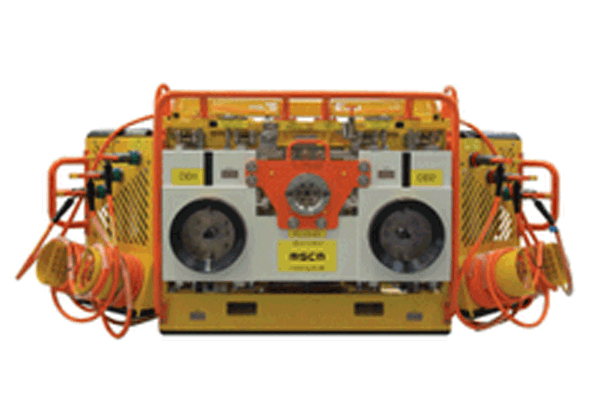
Daisy Chain Unit
Subsea Step-Out Hydraulic & Electrical Distribution Unit
Developed and designed to eliminate the procurement of additional expensive field umbilicals by offering the flexibility to hydraulically and electrically link (daisy chain) subsea step outs, removing the need for additional infield umbilicals and providing the ability to re-configure the field layout during field life.
The daisy chain distribution unit links two subsea trees, carrying hydraulic fluid supplies, methanol supplies and electrical connections between them for use in deep and shallow water applications. As a modularised, fabricated structure it is installed from a lift wire by a free-flying remotely operated vehicle, using a class 4 torque tool interface as described in API 17D and ISO 13628-8 for deployment on the subsea tree.
A unique guidance system, built around two fixed inboard junction plates (male stabplates) and an outboard junction plate (female stabplate), ensures repeatable mating even in poor visibility. A moving inner fabricated structure frame houses the hydraulic and methanol distribution lines, while generous vertical and lateral (±75mm) and angular (±10° on the X, Y and Z axes) tolerances accommodate as-built variation between adjacent trees.
Because the distribution unit and both hydraulic infield umbilical termination heads mate and de-mate under full system working pressure, the unit can be reconfigured on an operating field without a planned shutdown — a key advantage when step-out tie-backs are added after first oil. The assembly weighs 2200kg in air (1913kg in water) and measures 3413mm wide by 1600mm high.
Key Features
- Unique guidance system for repeatable, low-risk mating
- Two fixed inboard junction plates (male stabplates) and one outboard junction plate (female stabplate)
- Moving inner fabricated structure frame housing the hydraulic and methanol distribution lines
- Distribution unit and both hydraulic infield umbilical termination heads mate and de-mate under full system working pressure
- Modularised fabricated structure installed from a lift wire by a free-flying ROV
- Class 4 torque tool interface per API 17D and ISO 13628-8
Materials
Applications
- Distributes hydraulic fluid, methanol and electrical supplies from one subsea tree to a second subsea tree.
- Suitable for deep and shallow water step-out tie-backs, removing the need for additional infield umbilicals.
- Allows the field layout to be re-configured during field life.
Frequently Asked Questions
What problem does the daisy chain unit solve?
It hydraulically and electrically links (daisy chains) subsea step-outs — carrying hydraulic fluid, methanol and electrical supplies from one tree to the next — removing the need to procure additional expensive infield umbilicals and letting the field layout be re-configured during field life.
Can the field be reconfigured without a shutdown?
Yes. The distribution unit and both hydraulic infield umbilical termination heads mate and de-mate under full system working pressure, so step-out tie-backs can be added or re-routed on an operating field.
How is it installed?
As a modularised fabricated structure deployed from a lift wire by a free-flying work-class ROV, locking down through a Class 4 torque tool interface per API 17D / ISO 13628-8.
How does it achieve reliable mating between two as-built trees?
A unique guidance system built around two fixed inboard junction plates and one outboard junction plate, with ±75 mm vertical/lateral and ±10° angular tolerance on all three axes to absorb as-built variation — repeatable even in poor visibility.
How big is the unit?
3,413 mm wide × 1,600 mm high, weighing 2,200 kg in air (1,913 kg in water), with stabplates in UNS S31803 and couplings in Nitronic 50 HS.